How to Read Your Blood Test Report and Fix Common Deficiencies
Why blood tests matter for women, how to read a CBC, ferritin, vitamin D, B12 and thyroid report, and practical steps to correct deficiencies with food and care.
By Nitya Health Editorial Team8 min read
You got your blood test results, glanced at a page full of numbers, abbreviations and the odd value printed in bold or marked “H” or “L” — and then put the report away. That is very common. But that one sheet of paper is one of the most useful health tools you have. It can show iron, vitamin or thyroid problems months before they turn into serious fatigue, hair fall, irregular periods or trouble getting pregnant.
This guide explains why blood tests matter especially for women, how to read the most common values, and what you can do to improve a deficiency once you find one.
Why your blood test results matter
Many deficiencies develop slowly and quietly. Your body adjusts, and you get used to feeling a little more tired, a little colder or a little more low. By the time symptoms are obvious, stores may have been running low for a long time.
Women are at higher risk for several reasons:
- Monthly periods cause regular iron loss, and heavy periods increase it sharply.
- Pregnancy and breastfeeding raise the need for iron, folate, B12, vitamin D and calcium.
- Vegetarian and vegan diets — common in India — can be low in vitamin B12 and contain only the less easily absorbed form of iron.
- Thyroid disorders and PCOS are much more common in women and are closely linked to cycle, weight and fertility problems.
- Little time in the sun, covered clothing and indoor work all contribute to low vitamin D, which is widespread across India despite the sunshine.
A blood test turns vague symptoms into numbers you and your doctor can act on — and recheck later to see whether what you are doing is working.
How to read your blood test report
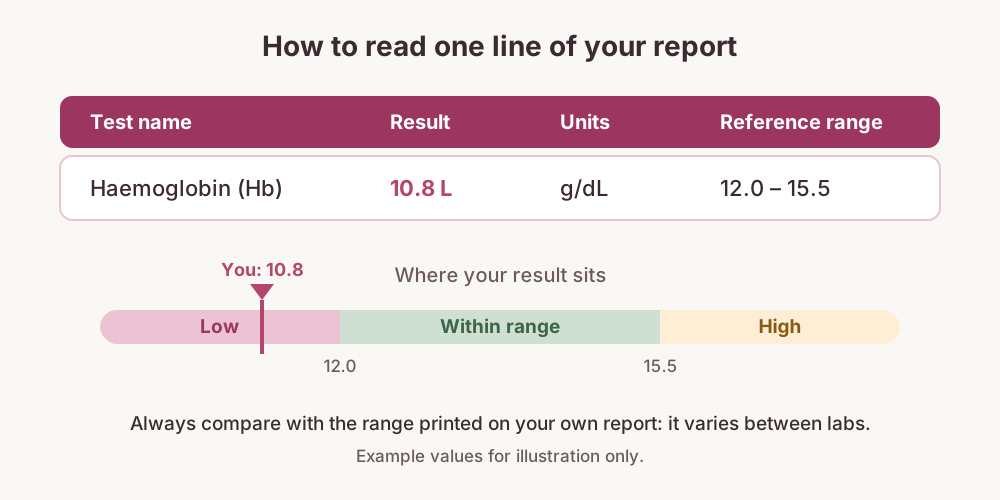
Most lab reports have the same four columns:
| Column | What it means |
|---|---|
| Test name | The marker being measured, such as Haemoglobin (Hb) or TSH |
| Result | Your value |
| Units | How it is measured, such as g/dL, ng/mL or pg/mL |
| Reference range | The range seen in most healthy people, as used by that lab |
A few points that help you read it correctly:
- Ranges differ between labs. Always compare your value with the range printed on your own report, not one you found online.
- Check the units. Vitamin D can be reported in ng/mL or nmol/L, and the numbers look very different.
- “Normal” is not always optimal. A ferritin of 16 ng/mL may sit inside a lab’s range, yet many women with values this low still feel tired and lose hair.
- One flagged value is not a diagnosis. Dehydration, a recent illness, fasting status or supplements taken that morning can all shift results.
- Look at trends. Comparing this year’s report with last year’s often says more than a single test.
If the medical terms feel overwhelming, a tool like Blood Test Report lets you upload a PDF or photo of your lab report and get a plain-language explanation of each value against its reference range. Use that summary to prepare questions for your doctor — not as a replacement for their advice.
Key tests every woman should know
Complete blood count (CBC)
The CBC measures your red cells, white cells and platelets. For deficiencies, the most important values are:
- Haemoglobin (Hb): the oxygen-carrying protein in red cells. For non-pregnant adult women, below 12 g/dL is generally considered anaemia.
- MCV (mean corpuscular volume): the average size of your red cells. Small cells (low MCV) often point to iron deficiency or thalassaemia trait. Large cells (high MCV) can point to vitamin B12 or folate deficiency.
- RDW: how much your red cells vary in size. It often rises early in iron deficiency.
Serum ferritin (iron stores)
Ferritin reflects how much iron you have in storage. It usually falls well before haemoglobin drops, so it catches iron deficiency early. A ferritin below about 15 ng/mL confirms iron deficiency, and many doctors consider values below 30 ng/mL low. Because ferritin also rises during infection or inflammation, a “normal” result does not always rule out low iron.
Vitamin B12
B12 is needed for healthy nerves and red blood cells. It is found almost only in animal foods, so vegetarians and vegans — and people on long-term metformin or antacids — are at higher risk. Low B12 can cause tiredness, tingling or numbness in hands and feet, poor memory, low mood and mouth ulcers.
Vitamin D (25-OH vitamin D)
Vitamin D supports bone health, muscles and immunity. Many labs consider below 20 ng/mL deficient and 20–30 ng/mL insufficient, though cut-offs vary. Low vitamin D can cause bone and muscle aches, low energy and frequent illness.
Thyroid (TSH, with free T4)
TSH is the main screening test for thyroid function. A high TSH usually suggests an underactive thyroid (hypothyroidism), which can cause weight gain, tiredness, feeling cold, hair fall and heavier or irregular periods. A low TSH can suggest an overactive thyroid. Thyroid problems are a common, treatable cause of irregular periods.
Blood sugar (fasting glucose or HbA1c)
HbA1c shows your average blood sugar over about three months. It matters especially for women with PCOS, who are at higher risk of insulin resistance and type 2 diabetes. Our HOMA-IR calculator can help you understand fasting insulin and glucose results together.
Common deficiencies and how to improve them
Here is what usually helps once a deficiency is confirmed. Your doctor will decide whether you also need supplements, and at what dose.
| Deficiency | Common signs | Food sources (vegetarian-friendly) | Helpful habits |
|---|---|---|---|
| Iron | Fatigue, breathlessness, hair fall, pale skin, cravings for ice | Rajma, chana, masoor, soya, bajra, ragi, halim seeds, sesame, green leafy vegetables | Pair with vitamin C; avoid tea or coffee within an hour of meals |
| Vitamin B12 | Tiredness, tingling, poor memory, low mood, mouth ulcers | Milk, curd, paneer, eggs; fortified foods | Vegans usually need a supplement or fortified foods |
| Vitamin D | Bone and muscle aches, low energy, frequent illness | Fortified milk or oils, egg yolk, mushrooms exposed to sunlight | Safe sun exposure on arms and legs; food alone is rarely enough |
| Folate | Tiredness, mouth sores; important before and during pregnancy | Green leafy vegetables, legumes, citrus, sprouts | Start folic acid before trying to conceive, as advised by your doctor |
| Calcium | Usually silent; long-term risk to bones | Milk, curd, paneer, ragi, til, tofu, green leafy vegetables | Space calcium supplements a few hours apart from iron |
Iron
Build meals around pulses, millets, seeds and greens, and add lemon, amla, tomato or guava to the same meal. Cooking in a cast iron kadhai also adds a little iron to food. For a full list of foods and a sample day plan, read our guide to iron-rich vegetarian Indian foods.
If your periods are heavy, treating the anaemia alone is not enough — the cause of heavy bleeding also needs attention.
Vitamin B12
Include dairy every day — curd, buttermilk, paneer or milk — and eggs if you eat them. If your level is low, diet alone is usually too slow; doctors often prescribe tablets, or injections when levels are very low or absorption is poor.
Vitamin D
Getting regular sunlight on uncovered arms and legs helps the skin make vitamin D, but how much you make depends on skin tone, season and time of day. Most people with a confirmed deficiency need a supplement for a period of time. Do not take very high doses on your own — vitamin D builds up in the body and too much can be harmful.
Protein matters too
Low protein intake can make it harder to recover from anaemia and can worsen hair fall. Our vegetarian protein diet plan shows how to reach your daily target with Indian foods.
Make a simple action plan
- Get tested, don’t guess. Many symptoms overlap — fatigue can be iron, B12, vitamin D, thyroid or poor sleep. Testing first prevents taking the wrong supplement.
- Understand each value. Note what is low or high, and what is near the edge of the range.
- Talk to your doctor. Take your report and a list of symptoms. Ask what is causing the deficiency, not just how to treat it.
- Follow the plan for long enough. Most deficiencies take weeks to months to correct. Stopping early is a common reason levels drop again.
- Retest. Rechecking after around 2 to 3 months (or as your doctor advises) shows whether the plan is working.
- Track how you feel. Logging your energy, mood, sleep and period flow in an app like Nitya Health makes it easier to connect symptoms with your results — and to explain them to your doctor.
A blood test is not just a check-up. It is a starting point you can measure your progress against.
When to see a doctor promptly
Do not wait for your next routine check-up if you have:
- Very heavy periods — soaking a pad every 1–2 hours, passing large clots or bleeding for more than 7 days
- Breathlessness at rest, chest pain, fainting or a racing heart
- Numbness, tingling or weakness that is getting worse
- Unexplained weight loss, ongoing fever or night sweats
- Haemoglobin well below the normal range, or a result your lab has marked as critical
A note on safety
- Avoid self-prescribing high-dose supplements. Too much iron, vitamin D or vitamin A can cause harm, and supplements can interact with medicines.
- If you have thalassaemia trait, small red cells may not mean iron deficiency, and extra iron may not be appropriate.
- During pregnancy, follow your doctor’s guidance on iron, folic acid, calcium and vitamin D, since needs and safe doses change.
This article is for general information and does not replace advice from a qualified doctor who knows your health history.
Frequently asked questions
Which blood tests should a woman get every year?
Many doctors suggest a complete blood count (CBC), fasting blood sugar or HbA1c, lipid profile, thyroid (TSH), and, especially for vegetarians and women with heavy periods, serum ferritin, vitamin B12 and vitamin D. Your doctor may add or remove tests based on your age, symptoms and history.
What does it mean if a value is marked high or low on my report?
It means the result falls outside the reference range the lab uses for most healthy people. A slightly flagged value is not always a problem, and a value inside the range can still be suboptimal for you. Always read it alongside your symptoms and discuss it with your doctor.
How long does it take to correct a deficiency?
It depends on the nutrient and how low you are. Haemoglobin often starts to rise within 2 to 4 weeks of iron treatment, but rebuilding iron stores (ferritin) usually takes about 3 months. Vitamin D and B12 levels are usually rechecked after around 8 to 12 weeks of treatment.
Can I correct a deficiency with diet alone?
Mild deficiencies can sometimes be improved with diet, but moderate or severe ones usually need supplements or injections prescribed by a doctor, along with diet changes. Diet is what helps you stay in range once your levels are corrected.
- #blood test
- #deficiencies
- #iron
- #vitamin D
- #vitamin B12
- #thyroid
- #women's health
Track it with Nitya Health
Log your cycle, symptoms and habits — and get answers from an AI health coach.